
“The ideal candidate will be highly organized …”
Hands up if you’ve ever read something similar on a job ad and thought, that sounds like me, but how do I prove it?
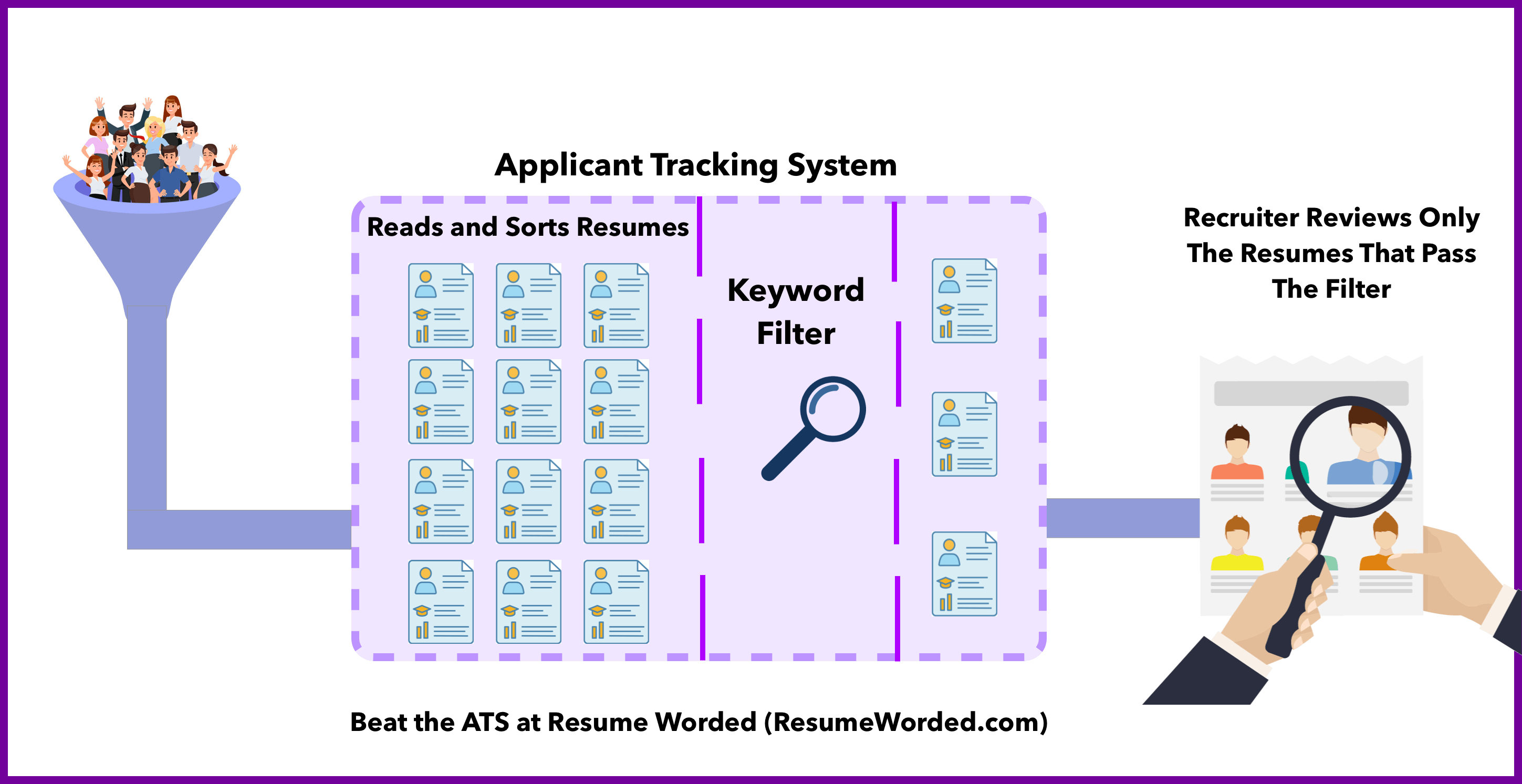
The answer is, through your accomplishments. Simply listing soft skills like organization isn’t impactful on a resume — at best, it’s an empty buzzword, and at worst, a red flag about your judgment. It also won’t help you get past Applicant Tracking Systems (ATS), which aren’t programmed to look for soft skills.
So, now that you know what not to do, here’s what to do instead.
How to say you're organized on a resume
Let's start with a quick step by step guide:
- First, consider what makes you organized. Are you physically organized? Mentally? Are you detail oriented? Can you organize other people? Are you good at coordinating projects or events?
- Read the job posting and look at the key responsibilities of the role. What type of organizational skills does it require?
- Think about a time you did something similar. Focus on what you did that required organizational skills, for example, organizing an event, creating a filing system, or leading a team or project.
- Start your bullet point with a relevant action verb. Verbs like Organized, Structured, Streamlined, Compiled, and Refined all speak to organizational skills.
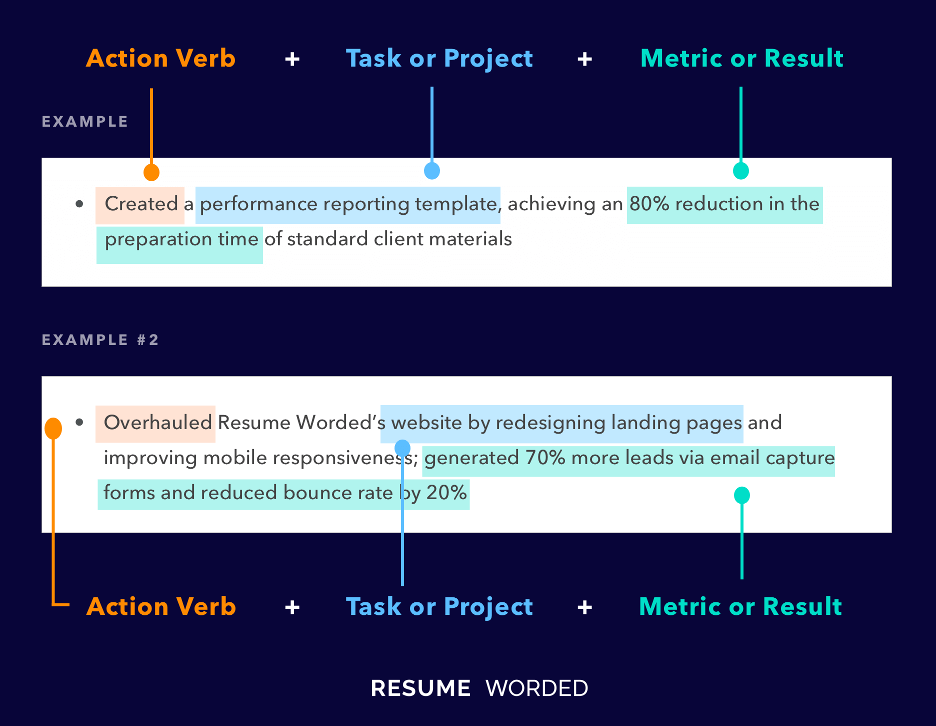
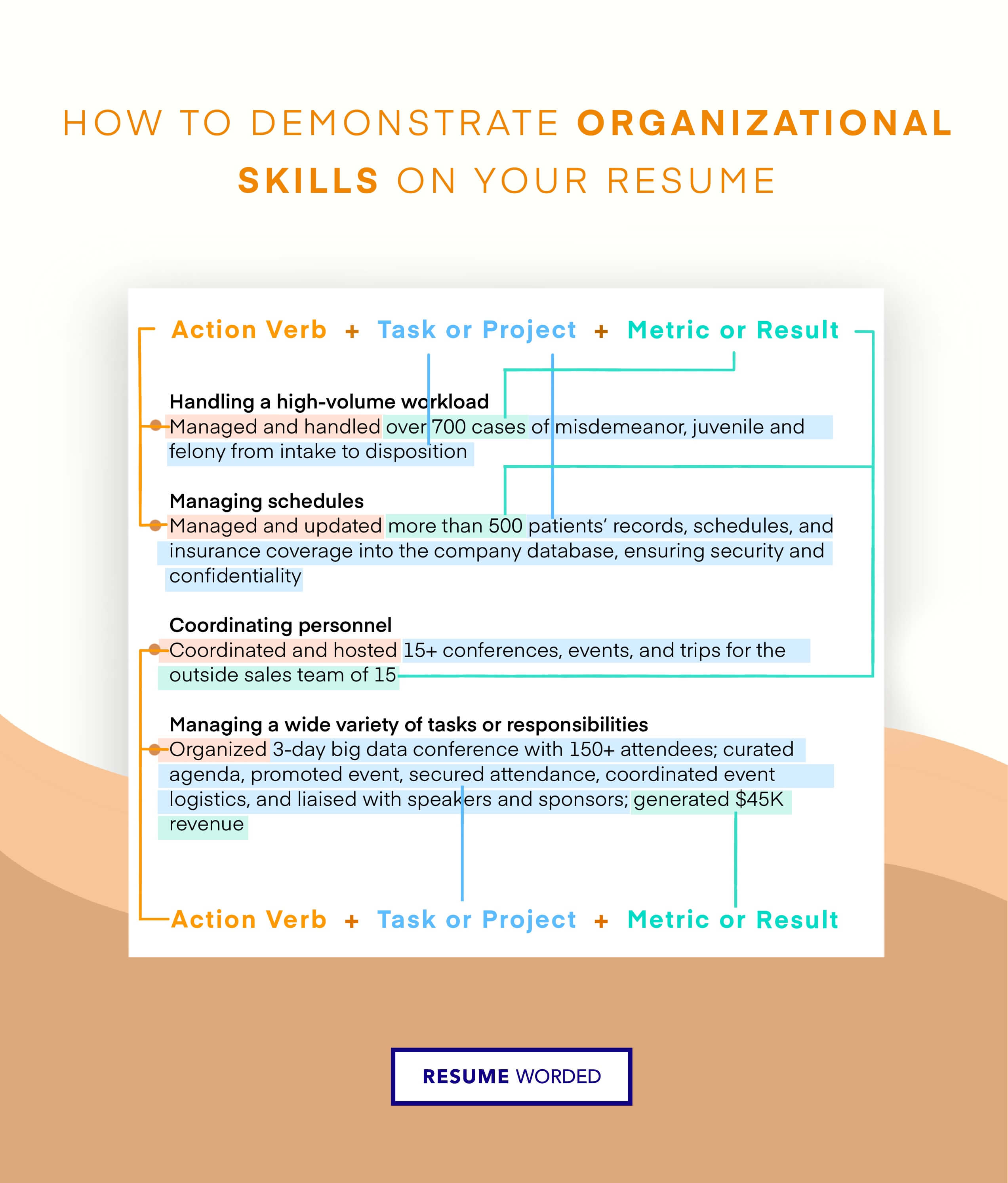
- Clearly state exactly what you did and what it achieved, using numbers wherever possible (see the example below).
- Aim to match each key skill or responsibility from the job description to an accomplishment on your resume.
- Once you’re done, upload your resume to a free resume checker to find out how your resume scores and how you can improve.
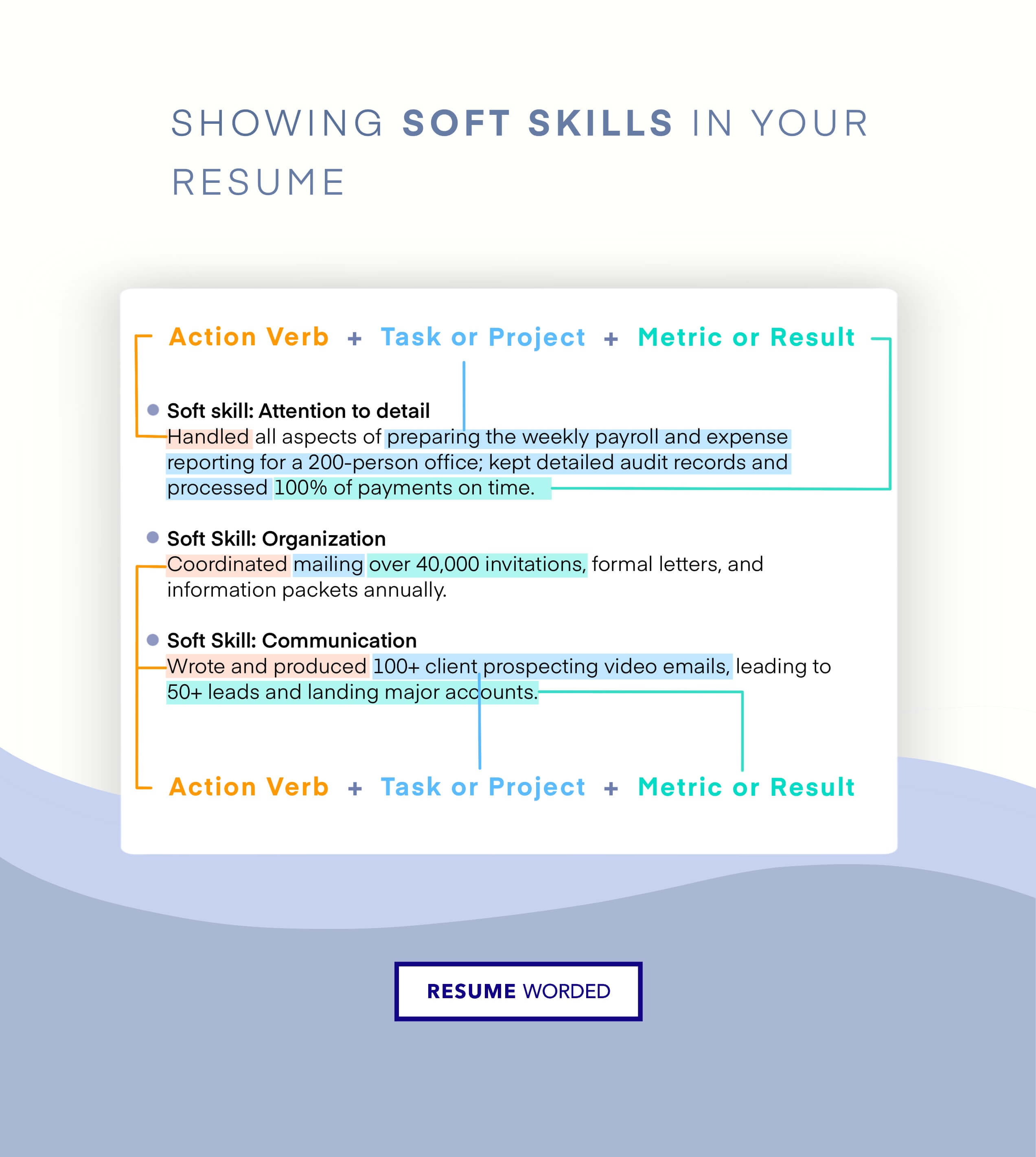
Here's an example of how to write an accomplishment using the framework we described above.
Find out if your resume shows enough organizational skills
The most effective way to list organizational skills, like any other soft skill, is to choose accomplishments that show how you have used these organizational skills in the past. Upload your resume to the tool below to find out if you have shown enough organization skills and other soft skills such as communication, leadership and attention to detail.
How to list organization skills
Listing organizational skills on your resume isn’t about what you say, but how you say it. Choose accomplishments that demonstrate your organizational skills in action, and don’t forget to back up your claims with hard numbers and metrics.
In your work experience section
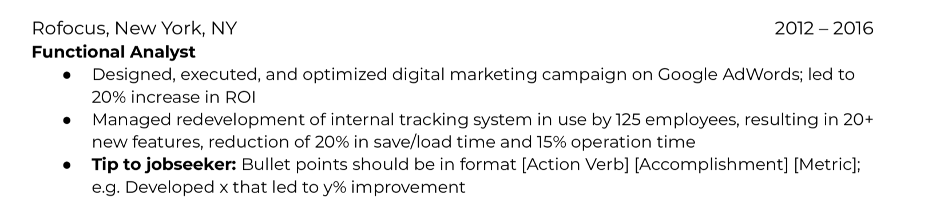
The best place for organizational skills on your resume is in your work experience section. It’s the section that hiring managers pay the most attention to, which makes it perfect for highlighting key skills. Let's see an example:
In your skills section
This doesn’t mean listing “highly organized” as one of your skills — that’s still a resume no-no — but if you have any relevant hard skills, including these in a skills or additional section of your resume can help reinforce your organizational skills. Technical processes, process improvement, and organizational software are all a good match.

Include relevant hard skills in your skills or other section.
Use the tool below to find relevant hard skills to add to your skills section.
In all stages of the hiring process
Recruiters don’t just rely on what’s on your resume when making hiring decisions — they also consider what they see with their own eyes.
Make sure your organizational skills are on displays when it counts. That means responding promptly to emails, showing up on time for interviews, including all the information you’re asked for in the job application or follow up conversations, and having a well organized and easy-to-read resume.
What organization skills should you include on a resume?
You should be carefully reading through the job description to get a good feel for the exact types of organizational skills the job requires, but in general, here are some multi-purpose organizational skills worth including in your resume:
| Skill | Type — and how to show it |
|---|---|
| Time management | Soft skill — prove it in a bullet point |
| Attention to detail | Soft skill — prove it in a bullet point |
| Scheduling | Hard skill — can also go in your skills section |
| Multitasking | Soft skill — prove it in a bullet point |
| Prioritization | Soft skill — prove it in a bullet point |
| Ability to meet deadlines | Soft skill — prove it in a bullet point |
| Event planning | Hard skill — can also go in your skills section |
| Leading a team | Soft skill — prove it in a bullet point |
| Project management | Hard skill — can also go in your skills section |
| Organizing files and data | Hard skill — can also go in your skills section |
| Handling confidential information | Hard skill — can also go in your skills section |
| Maintaining a neat and tidy space | Soft skill — prove it in a bullet point |
On the hard-skill side, name the tools you actually organize with — Asana, Trello, or Google Workspace in a skills section is concrete in a way “well-organized” never is.
Like the phrase “highly organized,” you shouldn’t just list these buzzwords on your resume. Instead, use your bullet point accomplishments to highlight organizational skills — and if you’re not sure exactly how to start, keep scrolling for examples.
Synonyms for organizational skills
If you want to highlight your organizational skills without repeating "organized" over and over, try these resume power verbs instead:
How to say you're physically organized on a resume
- Rearranged
- Centralized
- Filed
- Collated
- Standardized
- Remodeled
Instead of “organizational skills,” try: “Centralized document storage across 3 departments, cutting average file-retrieval time by 40%.”
How to say you're detail oriented on a resume
- Analyzed
- Charted
- Compiled
- Budgeted
- Calculated
- Reconciled
Instead of “detail-oriented,” try: “Reconciled 200+ vendor invoices per month, catching $18,000 in duplicate charges over the year.”
How to say you meet deadlines on a resume
- Scheduled
- Streamlined
- Accelerated
- Prepared
- Expedited
- Outpaced
Instead of “always meets deadlines,” try: “Streamlined the monthly close process from 10 days to 6 by scheduling task handoffs a week in advance.”
How to say you can organize projects and events on a resume
- Arranged
- Directed
- Orchestrated
- Managed
- Planned
- Overhauled
Instead of “strong project management skills,” try: “Orchestrated a 3-day sales conference for 250 attendees, delivering the event 8% under budget.”
How to say you can handle confidential information on a resume
- Secured
- Catalogued
- Recorded
- Monitored
- Regulated
- Encrypted
Instead of “discreet and trustworthy,” try: “Secured and catalogued 1,500+ patient records during a records-system migration with zero compliance incidents.”
Organizational skills vs. organization skills: is there a difference?
No — they’re used interchangeably, and recruiters and ATS treat them the same way. “Organizational skills” is the more common form on US resumes, which is why this page uses it. Don’t spend energy on the wording; spend it proving the skill with one of the verbs above.
Examples of organization skills
To help get you started, here are some examples of accomplishments that demonstrate organizational skills. You can use these as inspiration or as a template for creating your own bullet points.
- Organized new office and designed systems to maximize office function efficiency by 30%
Organizational skills are key for administrative positions. Highlight your ability to set up and run an office by emphasizing improvements you’ve made to individual systems or overall efficiency.
- Managed and updated more than 500 patients’ records, schedules, and insurance coverage into the company database, ensuring security and confidentiality
If the role you’re applying for requires you to organize things like files, data, and schedules, choose an accomplishment that demonstrates how you’ve previously done something similar.
- Assisted in managing call center operations of 800+ virtual agents, keeping oversight of performance, service fees, training, and contracting
Positions of leadership require strong organizational skills, especially if you’ll be coordinating teams who work remotely or from different locations. Be specific about the experience you have — including the size of the team and what functions you oversaw — to give hiring managers a stronger sense of what you can bring to the table.
- Managed and handled over 700 cases of misdemeanor, juvenile and felony from intake to disposition
Handling a large workload takes decent organizational skills. Emphasizing the number of cases, files, or requests you’ve handled is a good way to draw attention to your ability to organize a high volume of work.
- Managed outreach to 30 State agencies in one phase to gather data requirements needed for migration of email, calendars, shared resources, and devices from various platforms for over 6,700 accounts
The ability to multitask and keep track of many disparate elements is a highly sought after skill. Demonstrate it through bullet points that make good use of numbers and clear metrics to quantify your accomplishments.
- Efficiently processed all accounts payable and receivable invoices and ensured 100% of approved invoices were paid in full and on time while maximizing cash flow
Organization is a key skill in any job involving billing or finance. Use your work experience section to highlight your ability to do the job effectively and without mistakes.
- Coordinated and hosted 15+ conferences, events, and trips for the outside sales team of 15
Organizing functions isn’t just a valuable skill for event management — it also shows your ability to coordinate personnel and follow through to make sure nothing slips through the cracks.