The struggle to retain your individuality when writing a resume is very real. All too often resume writing can feel like ticking off a checklist or painting by numbers — sure, you’re doing everything “right,” but does the end result still feel like you?
What a lot of people don’t realize is that hiring managers want to see individuality in job applications. That doesn’t mean resorting to gimmicks, but it might mean banishing some of the more generic content from your resume. Read on to discover the resume buzzwords and clichés recruiters are tired of reading — and what to replace them with.
Why you should avoid buzzwords on a resume
What’s the real risk of sprinkling one or two of the above into your resume — especially if those same buzzwords appear in the job description itself? Relying on buzzwords in your resume can:
- Dilute your resume. Most of these words are so overused that hiring managers see them all the time, which weakens the overall message of your resume and makes it less memorable.
- Undermine trust. The lack of specificity in these buzzwords makes them seem less credible, which could cause savvy recruiters to question some of the other claims on your resume.
- Be a missed opportunity. A lot of these buzzwords are surface-level — they lack the ability to dig a little deeper and convey the true value of your expertise.
- Lack originality. Nearly every candidate would describe themselves as a team player with a good work ethic and strong communication skills. Focus on what sets you apart.
- Lead to miscommunication. Clichés are vague and subjective, which means they can be misinterpreted. Instead of relying on guesswork, describe what you really mean.
- Result in failed ATS screenings. Chances are, “creative” and “detail-oriented” aren’t on the list of must-have ATS keywords. If you use buzzwords instead of getting more specific, you run the risk of getting screened out even if you’re a great fit for the job.
I recommend uploading your resume to the tool below. It will help you identify relevant keywords and distinguish them from buzzwords that should be excluded from your resume.
How to avoid clichés on your resume
Let’s start with some quick tips on how to remove buzzwords from your resume.
- First, take a look at your resume. Does it accurately represent you, or does it describe a generic “ideal candidate?” If it’s the latter, you’re probably looking at a bunch of buzzwords that seem okay at first glance but don’t actually say anything.
- Identify the specific buzzwords and clichés that are letting you down. You can do this manually by highlighting the ones you can see, or you can use our list below to quickly search for some of the worst offenders.
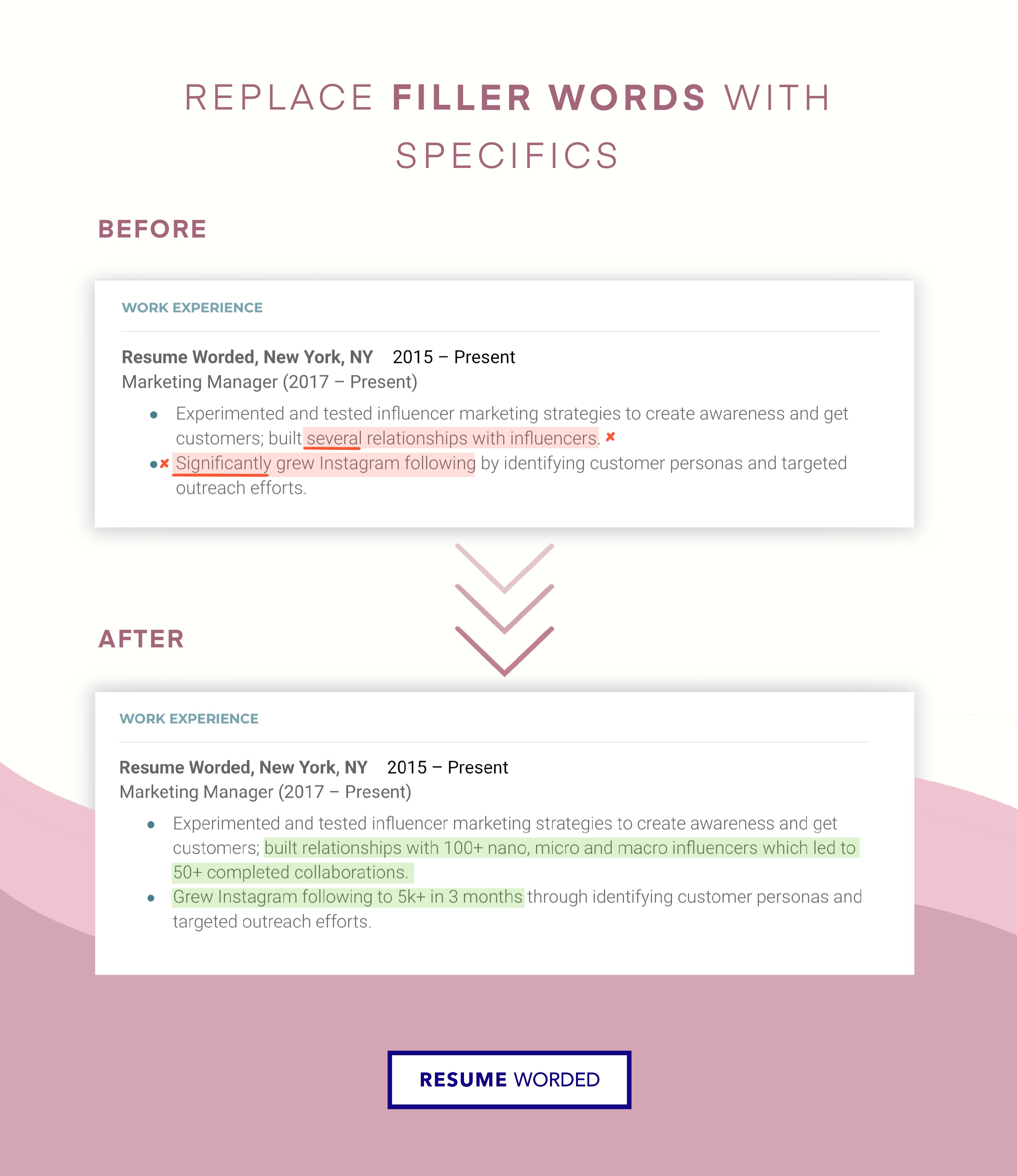
- For every buzzword you take out, replace it with something better. This is almost always going to be a specific example of what you actually did. For example, if you removed the phrase “strong leadership skills,” you should replace it by describing the size of the team you led and what you accomplished.
- Use specific metrics whenever possible. “Increased productivity” is good; “increased productivity by 48%” is much better.
- Don’t feel like you need to eliminate all industry-specific terminology. Not all jargon is bad — sometimes it’s the best way to quickly describe what you can do and emphasize your familiarity with the role or industry. For example, if you’re applying for a job in digital marketing, it’s okay to use common terms like “SEO” or “content strategy.”
- If you’re having a hard time differentiating between “good” jargon and “bad” buzzwords, try using a free resume tool that can quickly scan for overused resume words and suggest better alternatives.
- Try to keep up-to-date with language trends that are becoming outdated or clichéd. We’ve provided a handy reference list below to do the heavy lifting for you.
Common resume clichés (and how to improve them)
Now let’s take a look at some of the more egregious resume clichés we’ve seen. If any of these appear on your resume, you should seriously consider replacing them — check out these examples of real, impactful statements that do a much better job of saying what you want to say.
Buzzword: “Team player”
How to replace it: “Collaborated with a cross-functional team of 5 to successfully deliver a critical project 2 weeks ahead of schedule, improving the overall efficiency of the project by 20%.”
Buzzword: “Detail-oriented”
How to replace it: “Implemented a new quality assurance process that reduced project errors by 30%.”
Buzzword: “Creative”
How to replace it: “Designed a unique marketing campaign that drove a 50% increase in web traffic.”
Buzzword: “Good communication skills”
How to replace it: “Leveraged strong communication skills to facilitate a challenging negotiation with a major client, ultimately securing a contract worth $500k.”
Buzzword: “Hardworking”
How to replace it: “Managed and completed a complex project within a tight 3-month timeframe, receiving recognition from management for exceptional dedication and commitment.”
Buzzword: “Problem solver”
How to replace it: “Resolved a longstanding issue with the company's inventory management system, reducing stock discrepancies by 40%.”
Buzzword: “Strategic thinker”
How to replace it: “Designed and implemented a new content strategy that increased website traffic by 35% within six months.”
Buzzword: “Innovative”
How to replace it: “Developed a novel approach to data analysis that increased the efficiency of the process by 25%, saving approximately 10 hours of work per week.”
Buzzword: “Self-starter”
How to replace it: “Identified an opportunity to improve customer satisfaction and autonomously created a customer feedback system, which resulted in a 20% decrease in customer complaints.”
Buzzword: “Go-getter”
How to replace it: “Initiated and executed a process improvement plan that led to a 15% increase in team productivity within the first quarter.”
Buzzword: “Highly skilled”
How to replace it: “Applied my expertise in software development to deliver a feature-rich application that boosted the company's revenue by 18% in its first year.”
Instead of resorting to buzzwords and clichés, use the tool below to get a list of keywords relevant to the job you’re applying for.
More resume buzzwords and clichés to avoid
Starting to get the hang of it? Here’s a longer — but still not exhaustive — list of overused words to look out for on (and remove from) your resume:
- Results-driven
- Passionate
- Dynamic
- Proactive
- Experienced
- Highly qualified
- Top performer
- Think outside the box
- Value add
- Synergy
- Go-to person
- Thought leadership
- Industry expert
- Bottom line
- Big picture
- Motivated
- Track record
- Effective
- Seasoned
- Action-oriented
- Customer-focused
- Fast-paced
- Strong work ethic
- Leverage
- Cutting-edge
- Groundbreaking
- Hit the ground running
- Game-changer
- Guru
- Ninja
- Rockstar
- World-class
- Paradigm shift
- Robust
- Scalable
- Disruptive
- Innovative
- Holistic approach
- Agile
- Pioneer
Frequently asked questions about resume buzzwords
Are there any buzzwords you should use on a resume?
Yes — two kinds. Strong action verbs (implemented, streamlined, negotiated) at the start of your bullet points, and keywords taken from the job description itself: the skills, tools, and qualifications the employer explicitly asks for. Both work because they’re specific and checkable. The words to cut are self-descriptions — “results-driven,” “team player” — which any candidate can claim and no recruiter can verify.
What’s the difference between resume keywords and buzzwords?
Keywords name things — Python, forecasting, HIPAA compliance — and they’re what ATS software and recruiters actually scan for. Buzzwords describe yourself — dynamic, passionate, detail-oriented. Keep every keyword that matches the job description; treat every self-description as a candidate for deletion.
What are the most overused buzzwords on a resume?
The ones recruiters flag most often: team player, hard worker, detail-oriented, results-driven, go-getter, self-starter, passionate, and “think outside the box.” If a phrase could appear unchanged on a thousand other resumes, it’s doing nothing on yours — replace it with the accomplishment that made you want to claim it.